Attempted Bombing at the Mingo Concert
Mr. MercedesThe Attempted Bombing at the Mingo Concert is Brady Hartsfield’s attempt to repeat and magnify the mass killing he carried out at City Center. He brings a concealed explosive device into a concert venue, intending to detonate it among thousands of young fans, but Holly Gibney and Jerome Robinson reach him before he can activate it. Holly strikes Brady and removes a battery from the triggering device; the audience survives, and her split-second action becomes the decisive reversal of the plot’s central threat.
Background and Preparation
Brady’s plan is shaped by the earlier City Center attack, where he killed eight people by driving into job seekers gathered behind a maze of yellow DO NOT CROSS tape. That crowd had been compressed by the queue’s layout, and people near the entrance could not escape when the car charged. At the Mingo concert, Brady again targets a large gathering, but this time imagines a more extensive death toll: seeing the growing crowd, he thinks of driving into it before detonating an explosive. The possibility of repeating the earlier attack is both a memory and a measure of his ambition.
The venue’s access arrangements become part of the plan’s practical limits. During reconnaissance at the Midwest Culture and Arts Complex, Brady sees a corridor sign stating NO BAGS NO BOXES NO BACKPACKS. He expects more than four thousand concertgoers to pass through and assumes metal detectors will not be used, because screening everyone could create a severe bottleneck. He anticipates many security guards, however, and knows a conspicuous disguise or exposed wire could draw attention. The no-bags rule does not prevent his scheme: he chooses a wheelchair, whose pockets can hold the components without presenting as a prohibited bag.
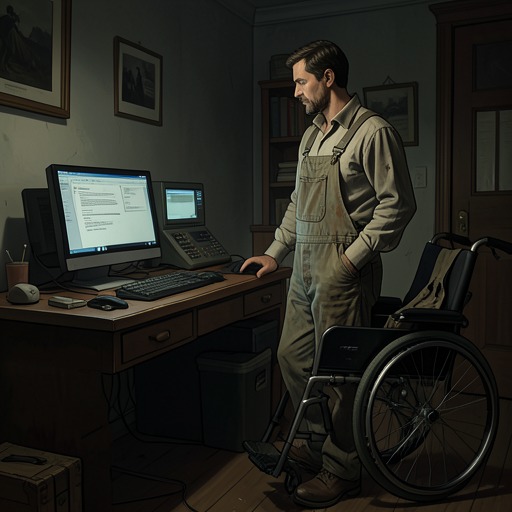
Just before six in the evening, with the show still more than an hour away, the parking lot is already three-quarters full and lines are growing. Brady parks his Subaru behind a roughly fifty-foot ’Round Here support trailer, using it to hide the car from the busy lot. He puts on fake glasses, retrieves a wheelchair, and connects explosive blocks concealed in its pockets to the wiring routed through an ASS PARKING cushion. His oversized concert shirt bears the same Ferris wheel logo as the support truck and the words KISSES ON THE MIDWAY, making his appearance fit the event rather than advertise the device. He tests Thing Two, the car-signal capture device adapted here to activate the bomb’s circuit, and sees its yellow ready lamp illuminate.
The Plan Meets the Venue
Brady’s preparations are makeshift, and he recognizes the weakness even as he proceeds. He has not effectively concealed every wire, and a quick look into the wheelchair’s storage pockets could expose the device. He also cannot incorporate the explosive-filled Urinesta peebag into the circuit as he intended, but assumes the other components will be sufficient. The plan depends less on a secure disguise than on the hope that the crowd, music, and routine of entry will keep security from inspecting him closely.
That expectation fails when the concert staff admits wheelchair users through a separate handicapped-access line before the general crowd. In the lobby, wheelchairs move slowly toward the checkpoint along the corridor’s roped-off right side, while ordinary concertgoers have not yet been let in. Brady had expected everyone to press forward at once and overwhelm the guards; instead, the separate, orderly route leaves wheelchair users exposed to closer scrutiny. He realizes that the arrangement is not the one he had counted on, but continues toward the checkpoint.
As he rolls forward, Brady keeps a framed picture of Frankie in his lap, with its edge resting against the toggle switch. He intends to press down on the picture if a guard examines the wheelchair, completing the circuit and sending electricity to the detonators. The queue narrows the remaining distance: a dozen wheelchairs are ahead, then ten. Nearby, a guard takes a backpack from a young girl and gives her a claim check. Brady’s earlier massacre returns to his thoughts, including his excitement at City Center and the deception he used afterward to explain his hoarse voice. The venue’s ordinary controls—separate access, inspection, and the handling of a bag—bring his private recollection into contact with the present danger.
Intervention and Disarmament
Holly reaches the seating area while Brady is still positioned to trigger the bomb. Her first impression is that he is looking away from the stage toward Barbara Robinson and making an obscene gesture. His hand is beneath the framed picture on his lap, and Holly fears that he is preparing to activate the device. She cannot exchange places with Jerome, who has the revolver, and has only seconds to act. Instead of announcing his identity, she calls him by a false name, Mike Sturdevant, startling him into turning toward her.
Holly swings the knotted sock Bill Hodges gave her, the Happy Slapper, and strikes Brady in the head. His hand knocks the framed photograph of Frankie to the floor, where its glass breaks. While the concert audience continues clapping and singing, Jerome reaches Holly and asks what Brady has under his shirt. Holly hits Brady a second time, then stops a wheelchair user from reaching toward him by warning that he has a bomb and that it may be active. This intervention protects the nearby girl as well as the larger crowd: the device is not merely a threat being carried by Brady, but a live hazard within reach of other people.
The visual clue that matters next is the yellow ready lamp beneath Brady’s shirt. Holly takes Thing Two from his stomach, but cannot tell which direction of the toggle means off and which means detonation. Rather than move the switch blindly, she studies the remote and removes its battery cover. Inside are two AA batteries. As Jerome holds Brady’s hands, one slips free and strikes Holly; the movement dislodges the battery she has been trying to reach. The world does not explode. The yellow light goes out, and Holly pulls the master wire free from Thing Two. The device is no longer ready to trigger.
Outcome and Significance
The immediate outcome is averted mass death. Brady’s plan was aimed at a concert audience numbering in the thousands, and he had deliberately exploited the wheelchair route and the crowded event setting. The attempt ends not through a successful police checkpoint intervention but through Holly’s rapid judgment under pressure, Jerome’s assistance in restraining Brady, and the accidental movement that removes the battery. The distinction matters: the device is disabled by a small physical interruption in a plan built from multiple connected components.
When Holly begins to tell Jerome that he can release Brady, Jerome has already let go and is embracing her. The audience is still cheering, unaware that the celebration has coincided with their rescue. Holly tells Jerome that they are really cheering for them, though they do not know it. The concert’s music and crowd noise thus cover the intervention even as the event’s public gaiety becomes an unintended counterpoint to the danger unfolding among the wheelchairs.
The attempted bombing also brings together the novel’s two mass-casualty episodes through contrasting crowd conditions. At City Center, applicants were packed into a constrained, taped queue when Brady drove into them; at the concert, a separate access line gives him the route he means to exploit, but also makes his approach to the checkpoint slower and more visible. In both situations, the crowd’s organization shapes who is exposed and whether people can respond. At Mingo, the potentially lethal plan is stopped before the audience recognizes the threat, and the ordinary concert continues without understanding how close it came to catastrophe.